

Just a quick note: You’ve probably noticed that I grabbed a custom domain for this newsletter. If you’re on X and inclined to share it, the link will now display normally rather than get buried by the algorithm. Any shares are appreciated.
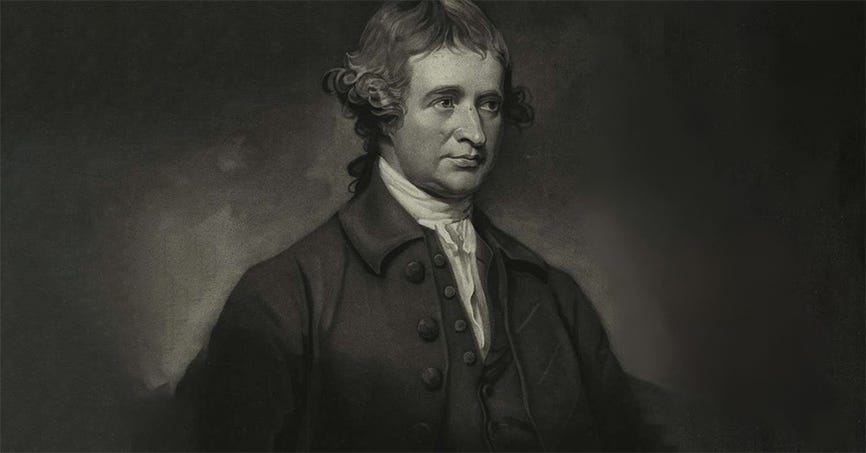
When it comes to the philosophy of how government should function—and how those who govern should behave—I always turn to Edmund Burke. His writings are excellent (I really need to revisit some of them) and, at least for me, serve as a valuable starting point.
I thought of Burke when I came across an old article by Sarah Isgur at The Dispatch titled “The Quiet Lawlessness of Joe Biden.” In it, she details—against the backdrop of endless “what about…?” examples—how Biden, the supposed “restorer of norms,” abused his executive authority during his four years in office. That includes the campaign to lie about and conceal his deteriorating health and mental acuity to run for another term.
Now, I’ll stop you right here. I can already feel the spittle-flecked outrage about Donald Trump, and we’ll get to him soon. This isn’t about blame, comparisons, or deciding which “side” is worse (I could write 1,500 words on my disdain for the “sides” debate, which is both trite and utterly annoying). I’m simply using Sarah’s piece as a starting point for what follows. Good? Good.
Burke, in Reflections on the Revolution in France, wrote:
“Men are qualified for civil liberty in exact proportion to their disposition to put moral chains upon their own appetites. Society cannot exist unless a controlling power upon will and appetite be placed somewhere; and the less of it there is within, the more there must be without. It is ordained in the eternal constitution of things, that men of intemperate minds cannot be free. Their passions forge their fetters.”
Burke was a strong advocate of restraint in government—the idea that true liberty comes from self-restraint and limited government.
Of course, the word “restraint” means nothing to Trump. Forget the bull in the china shop; Trump is a Category 5 hurricane in a house of cards. But whatever Trump has done—arbitrary tariffs, use of the military in civilian situations, targeting drug cartels as terrorists, immigration raids, political prosecutions, freezing federal funds, mass layoffs—or will do, does not exist in a vacuum. Yes, what he’s done is worse. But that doesn’t make what any other president has done better.
The idea that “not as bad” equals “good” is nonsensical. If there are two men in a room, and one has raped two women while the other has raped five, the first is not “better.” He’s still a rapist. Ed Gein is not “better” than Dennis Rader (the BTK Killer) because Gein murdered two people while Rader killed at least ten.
This is why the “Stop trying to both-sides it” line annoys me. It is on both sides. It doesn’t matter if Trump is worse—and he is. That doesn’t give anyone permission to wave off the past because it’s inconvenient to discuss. That’s essentially the point Sarah was making.
Take Biden’s attempt to wipe out nearly $500 billion in college debt. For years, Biden and other Democrats—including Nancy Pelosi, who a year earlier said Biden needed congressional approval—acknowledged that eliminating college debt required an act of Congress. Because it essentially amounted to an appropriation (money owed to lenders doesn’t turn into fairy dust, à la Matthew McConaughey in The Wolf of Wall Street), lawmakers had to approve it.
Biden did it anyway, relying on a legally flimsy claim that he and the Secretary of Education had broad authority under the HEROES Act. When he acted, other Democrats wilted like week-old lettuce. Pelosi reversed herself and said he “clearly” had the authority. As we know, the Supreme Court struck it down. But that didn’t stop the president. He tried again and boasted, “The Supreme Court blocked me, but it didn’t stop me.” Another example of restraint in short supply.
President Obama did something similar with DACA. He repeatedly said he didn’t have the authority to implement Deferred Action for Childhood Arrivals on his own.
In 2010, Obama said, “I’m President; I’m not king. I can’t do these things just by myself.”
In March 2011, he said that “with respect to the notion that I can just suspend deportations through executive order, that’s just not the case.”
Two months later, he said he couldn’t “just bypass Congress and change the (immigration) law myself. ... That’s not how a democracy works.”
Then in 2012, he did it anyway.
Naturally, people argue, “But what Biden and Obama wanted to do was good.” I get it. People are frustrated that Congress can’t pass meaningful, bipartisan legislation on serious issues. But frustration is not a permission structure for any president to declare, “I’ll do it myself.”
Part of the problem is that “bipartisanship” has become a dirty word. When Congress passed Biden’s infrastructure bill with ten Republican votes in the House, Rep. Marjorie Taylor Greene called them “traitors.” The current government shutdown is being driven largely by the progressive wing of the Democratic Party, which refuses to open the government without getting what it wants. It’s reminiscent of the Tea Party era (2011–2013), when a handful of members thought they could force a Democratic Senate and president to accept their spending priorities.
We also have to think about the future. Too many people assume JD Vance will win in 2028. What if he doesn’t? What if President Newsom or President Buttigieg decides to cancel Defense Department contracts and lay off civilian personnel en masse? What if they redirect funds appropriated for the Department of Energy to the Department of the Interior? What if one decides to “pass” a single-payer health care plan by executive order?
For those who say, “That wouldn’t happen,” I ask: Why not?
What would stop them? They might promise not to do it—but Biden promised to work with Congress on student loan forgiveness. When he realized it wouldn’t pass, he went beyond his authority anyway.
I could spend another thousand words explaining how this could all play out again, but at this point, it’s not in the cards. Have we reached a point of no return? I’m an optimist. I hope the system will return to some sense of normalcy—but I don’t see it happening in the next election cycle or beyond.
What it will take is a leader willing to remind Congress of its superior role (the “coequal branches” language is a myth), to tell members to get to work, talk to each other, stop chasing viral clips, posting on social media, and running to cable news cameras.
That should happen without the qualifier: “If you don’t act, I will.”
It would be refreshing to hear a president say, “If Congress doesn’t act, nothing gets done. And perhaps you should elect representatives who will do their jobs and work with each other to move the country forward.”
Wouldn’t that be a nice change?
Yes. That would be a very nice change indeed.