


I’m an older guy, and the first election in the United States I really took an interest in was the 1992 election. I was old enough to vote in 1988, but like many teenagers, I couldn’t have cared less about politics and didn’t bother.
1992 was different. You had George H. W. Bush, two years after his victory in Iraq but with an economy on the downside. There was Bill Clinton — the first of the Boomer generation to run for president — and, of course, Ross Perot.
I don’t need to go into everything that happened, but I can say that my first introduction to the BS of politics came from Bob Woodward’s book The Agenda. It was primarily about Clinton’s first year in office and the administration’s efforts to get its tax and spending plan through Congress. Democrats controlled the Senate 55–45 and already had four Republicans on board to secure the 60 votes necessary to bring it to the floor. The one holdout, ironically, was a Democrat — then-Nebraska Senator Bob Kerrey, who was not a fan of the “soak the rich” mentality. Warren Buffett convinced him it was not a big tax hike for the wealthiest Americans, and it passed.
The key issue illuminated in the book was Clinton’s promise to cut taxes for the middle class. I still recall when he went on television saying how hard he worked to get that done but couldn’t follow through. The book, however, tells a different story — one in which they knew during the campaign that he would not be able to get it done but went on saying it anyway.
Naturally, it sounds like garden-variety BS, but at the time, for someone new to the game, it was a real eye-opener. The overall point I’m making here is that I’ve been involved in this at several levels for over 30 years.
Politics was always an aside for most people. Sure, as a new conservative in the mid-’90s, I listened to talk radio, read National Review, and watched Crossfire on CNN (becoming a big fan of Robert Novak). Then, for more pointy-headed stuff, I liked to watch Capital Gang Sunday, which was hosted by Jim Glassman — a panelist show that would be unrecognizable in today’s world. For the most part, life was just life. You knew what you believed and largely avoided discussing it in polite company.
In the movie Sleepers, there’s a scene in which the young boys are grown men. Tommy Marcano and John Reilly (played by Billy Crudup and Ron Eldard) walk into a bar. They hear two guys talking politics of some kind, and it goes like this:
John: Hey, Jerry... What are they talking about? (Jerry is the bartender)
Jerry: They’re talking about Reagan’s speech. (This is 1981)
John: Order those two men some drinks and put it on my tab. You tell them that Republicans are not welcome in Hell’s Kitchen and either a political conversion or a change of conversation is in order.
Jerry: Sure thing.
Jerry walks to the other end of the bar and says, “The gentlemen there would like to buy you a drink on one condition. You know the rules: No religion and no politics.
Granted, they looked down the bar and saw two thugs staring at them, so they changed the subject. However, the more important point is what Jerry said about “the rules.” You don’t talk politics or religion in certain settings. And it stayed that way up until the last 10–15 years.
I hear all the time about how “our politics is broken” or how the government cannot function because of “broken politics.” While partially true, that’s more the result of something deeper — it’s not the root issue.
The government merely responds to the whims of voters, especially those with the loudest voices. And it’s those voters and activists — on both the left and right — who make up approximately 40% of the voting populace. When Arthur Brooks was leaving AEI in 2018, he spoke with Tim Alberta and said,
“It’s not like 50 percent of Americans thinks one thing and 50 percent thinks another thing. No, 15 percent on each side are effectively controlling the conversation, and 70 percent of us don’t hate each other.”
I think the figure has increased in the last seven years, which is why I’m saying 40%.
The 20% on the right and the left have little to do with ideology. It’s not about the “far left” or the “far right.” It has much more to do with those who’ve made politics such a significant part of their identity that it’s like religion — everything is personal. Just as with religion, people pass judgment on others over their political views. As with certain religious sects, people choose not to have friends, or end friendships, over politics. People avoid certain places or refuse to buy certain products because of politics. When I see someone say, “They want you dead,” whether on the left or the right, I think to myself, What is going on in this person’s head?
And when I talk about it as religion, I don’t mean the kind of religion that guides people and brings them spiritual health. I’m talking about the rigid, rules-based version rooted entirely in black-and-white principles of good and evil — and again, judgment. Think about the preacher who says anyone who listens to music other than hymns is a sinner engaging in evil. That’s the mindset I equate with the level of politics that has consumed so many people.
I’ve been doing this professionally for nearly 10 years now. As a writer, I’m an observer. And as someone with opinions, I base them on my beliefs; if that conflicts with a party or a politician, oh well. I’d get yelled at all the time by people saying, “Why are you criticizing Republicans? Go after the other side!” Of course, I don’t play for a team. I was never hired by the Republican Party to be a mouthpiece for them. As a conservative, the GOP was, for the longest time, the best vehicle in politics to advance conservative ideas and policies.
At the same time, I don’t allow myself to get consumed by politics. I write about it, talk about it on social media, and work with it in many respects — but when the day is over or the weekend arrives, I have different priorities. I don’t constantly consume political podcasts, watch cable news, or spend hours upon hours on social media.
Here’s what I like to do: I like watching YouTube channels where people get old cars back on the road or convert them into something entirely different — Vice Grip Garage, Fab Rats, The Dirthead Shed, Stay Tuned, Junkyard Digs. If you want to see some crazy stuff (what they call “Redneck Science”), check out Westen Champlin. He recently swapped a Rolls-Royce engine with a Cummins.

On the weekends, I’d rather do stuff with the family vehicles. I’m coming up on 60,000 miles on my Tacoma (I just changed the oil for $45 instead of paying someone else $100), and I’ll change the differential fluid, transfer case fluid, and do a drain-and-fill on the transmission fluid (not a flush). Andrea and I like to watch The Great British Baking Show, Triple Threat with Bobby Flay, and Alex vs. America. That’s relaxing and helps me get my mind off politics.
I also don’t care who someone voted for in a given election. Sure, I might disagree with someone’s choice, but that doesn’t change my view of them as a person or friend. It just doesn’t matter. Sure, policy matters. Laws matter. Regulations matter. The political process was designed so people could have a say on those issues through their elected representatives. But now people have latched onto the notion that the person you vote for defines you — or that whatever that person does is your responsibility.
One of the more pernicious post hoc fallacies used by people, particularly on social media, is when a politician does something and someone says, “If you voted for that person, you own this!” or “You’re complicit!” The post hoc fallacy holds that because one event preceded another, they must be causally related. Therefore, your vote for Trump, Biden, or Obama is the cause of something they did — which is just ridiculous. It’s also lazy.
This has become somewhat of a stemwinder, but there’s one last thing I want to say about all of this: you don’t have to opine on everything. It’s perfectly fine to stay quiet. When people say you “have” to speak out or “should” say something — you don’t. That’s just another fallacy — in this case, an argument from ignorance: “Oh, if you don’t speak out about it, you either agree or don’t care!” Ryan Holiday said it best:
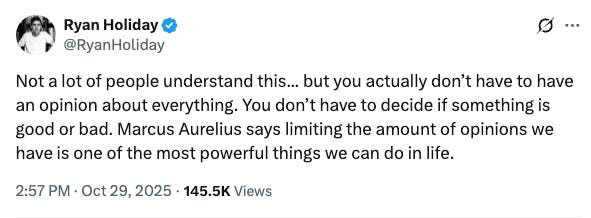
If everything you do or say, consume, read, listen to, or watch runs through a political prism, take a break. Life’s too short to waste time being angry at a particular portion of the population. It’s unhealthy mentally, unhealthy for relationships, and takes time away from doing things that can make you happy.
What do you think? Am I off base? Let me know in the comments.
I would agree with you until Trump came on the scene. To me, support for him does not just indicate policy differences - it symbolizes holding a totally different set of values and a rejection of almost everything I value about this country. His supporters are complicit in the destruction of our political system - the replacement of reasoned consensus with domination, ethical mores with every man for himself corruption, kindness with cruelty, democracy with authoritarianism, respectful disagreement with utter subservience to the leader and hatred of those who hold different opinions, scientific curiosity with dogmatic anti-intellectualism. He is leading our country on a path to ruin and I cannot just pretend that anyone who supports him deserves to be treated as a moral equal.
I agree with a lot of this and 1992 was the first election I was eligible to vote in and I was a precinct manager in the SC GOP Primary for President that year back when the state parties ran their own primaries.