

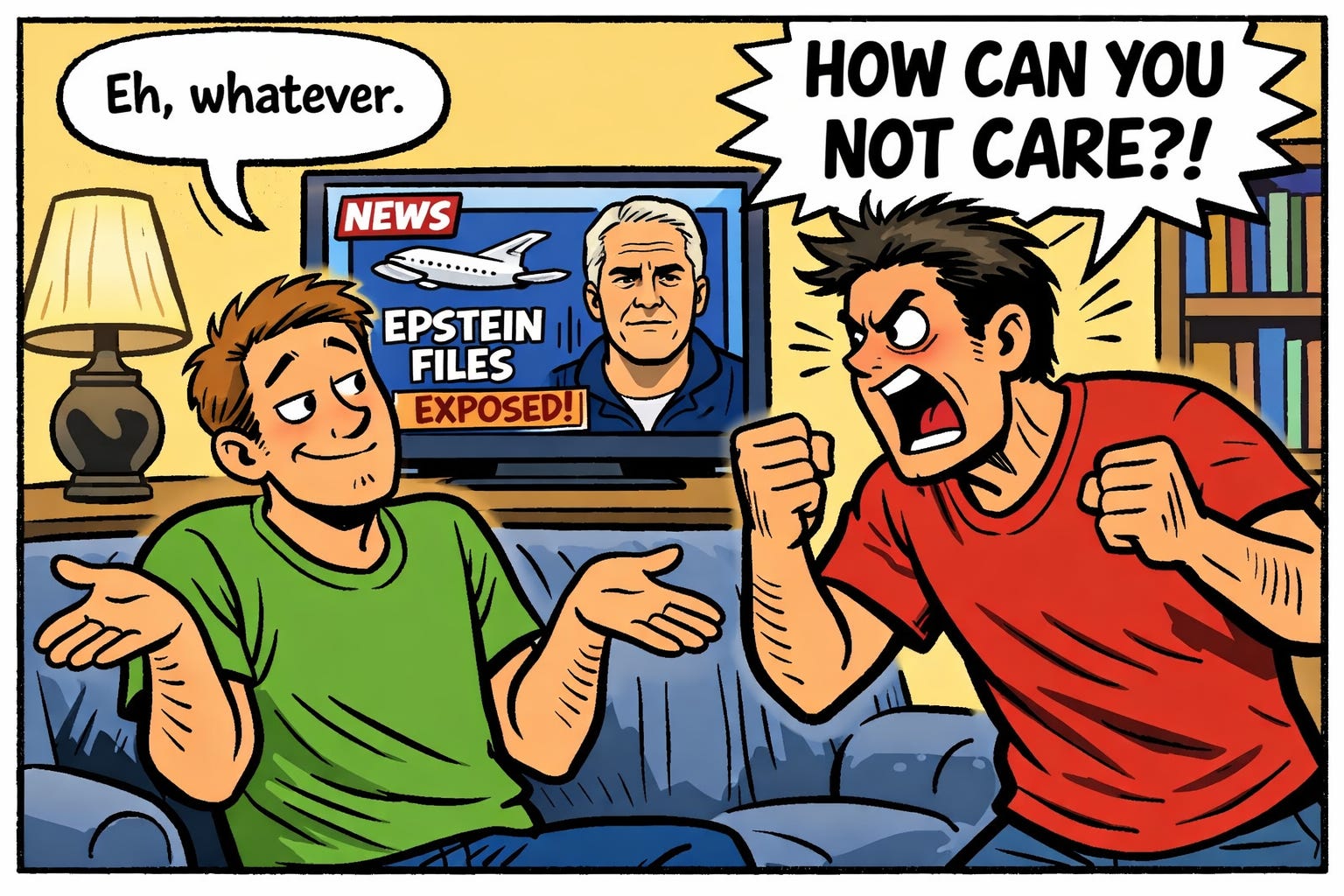
A while back, I wrote about how politics has become the new religion for many people. The parallels are hard to miss once you see them — the tribal identity, the heretics, the ritual performances of belief. This newsletter is something of a companion to that one, because there’s a specific demand that comes baked into the politicization of everything, and it’s one I’ve been thinking about quite a bit lately, especially with all that is going on around the world.
The demand is this: you must care. About everything. All the time.
The Epstein files drop, and if you’re not interested, it represents that you don’t care about abused underage girls or getting pedophiles off the streets. The Trump administration is taking unprecedented action in Venezuela, and if you don’t have an opinion, you lack basic human empathy. Take almost any issue with a tangential relationship to politics, and if your view is indifference, there must be something wrong with you. The logic (if that’s what you want to call it) is always the same in that emotional investment equals moral seriousness, and the absence of it makes you a bad person.
And I am going to push back on that pretty hard.
Someone on Instagram put it in a way that stuck with me. He said if you are emotionally invested in something you have no power to change, that’s not empathy — it’s ego. Just let that marinate for a second, because it reframes the whole conversation. It’s not that you care deeply about the Epstein files. It’s that your sense of yourself requires you to be the kind of person who cares about the Epstein files. Those are very different things, and only one of them is actually honest.
There’s a more significant issue worth examining here: the tension between empathy and anxiety. Empathy is the genuine capacity to understand and feel for another person’s situation. Anxiety is absorbing distress about things you cannot affect. What politics, the 24-hour news cycle, and social media especially ask of us almost constantly is the second thing dressed up as the first. Doom-scrolling over an issue for forty-five minutes isn’t empathy. It’s consumption. The people actually doing something about it probably think about it with far less emotional noise than the person getting worked up about it on X, TikTok, IG, Bluesky, etc. Those people actually have agency. The rest of us are largely spectators, many of whom convince themselves they’re participants.
The Stoics understood this a long time ago. I’m not a devotee in the Ryan Holiday sense. I don’t have a morning routine built around it, and I don’t base my entire life around it; the others do. However, I’ve always kept a copy of Meditations around and found it useful to just flip to a page and read. It’s not really a book in the conventional sense anyway, more like a journal that Marcus Aurelius kept to talk himself down from his own worst impulses. What strikes me about it is that here was a man running an empire, and yet he still had to remind himself not to let things outside his control take up residence in his head. If he needed that reminder daily, the rest of us probably do too.
Epictetus, a former slave, built his entire philosophy around one distinction: what is “up to us” and what isn’t. You focus your energy on the former and make peace with the latter. This wasn’t a philosophy of coldness or checked-out indifference. It was a philosophy of sanity and of honest self-assessment about where real influence begins and ends.
Much modern psychology has largely caught up with what the Stoics were saying, even if it uses different language.
Albert Ellis, who developed Rational Emotive Behavior Therapy, made a similar argument in the 1950s in his own unique way. Ellis was blunt to the point of being abrasive. He was a sarcastic smartass, which I kind of like. His core idea was that emotional disturbance doesn’t come from events themselves but from irrational beliefs we attach to them, especially the belief that we must feel a certain way about something, or that events happening far outside our lives are nonetheless personal catastrophes we must suffer over. He wouldn’t have much tolerance for the performative outrage that inhabits so much of society today and likely would have attributed it to something neurotic as opposed to noble.
Jonathan Haidt, who is very much a current thinker and one whose work I think holds up well, offers another piece of the puzzle. His argument in The Righteous Mind is that our moral emotions evolved from small-group living, in communities where you knew everyone, where your actions had direct consequences, and where the stakes were immediate and personal. The difference now is, we’re running that same emotional hardware on a global news cycle that delivers a deluge of things to feel strongly about. We’re simply not built to absorb all of it in a healthy way. The anxiety and outrage aren’t signals that we’re more morally engaged than previous generations. There are signs that we’re running a system past its design limits.
Which brings me back to the ego point. There’s a well-established concept in psychology around what’s sometimes called moral identity, which is the need to see yourself, and be seen by others, as a good and virtuous person. Clearly, there is nothing wrong with that on its face. The problem is when the performance of caring becomes a substitute for actually doing anything, because the performance feels like enough. You signal that you’re paying attention. You’re one of the good ones, and you care. And then you close out of whatever app you’re on and go about your day, having changed…nothing.
This connects directly to the religion parallel I wrote about before. In the same way that political ideology has replaced theology as an organizing framework for a lot of people’s identity, political outrage has replaced guilt and confession as the mechanism for demonstrating your worthiness. Not caring has become the new sin. And like religious guilt, it doesn’t actually help anyone; it just keeps you inside the system, performing. Look this example from Jonathan Last at The Bulwark:
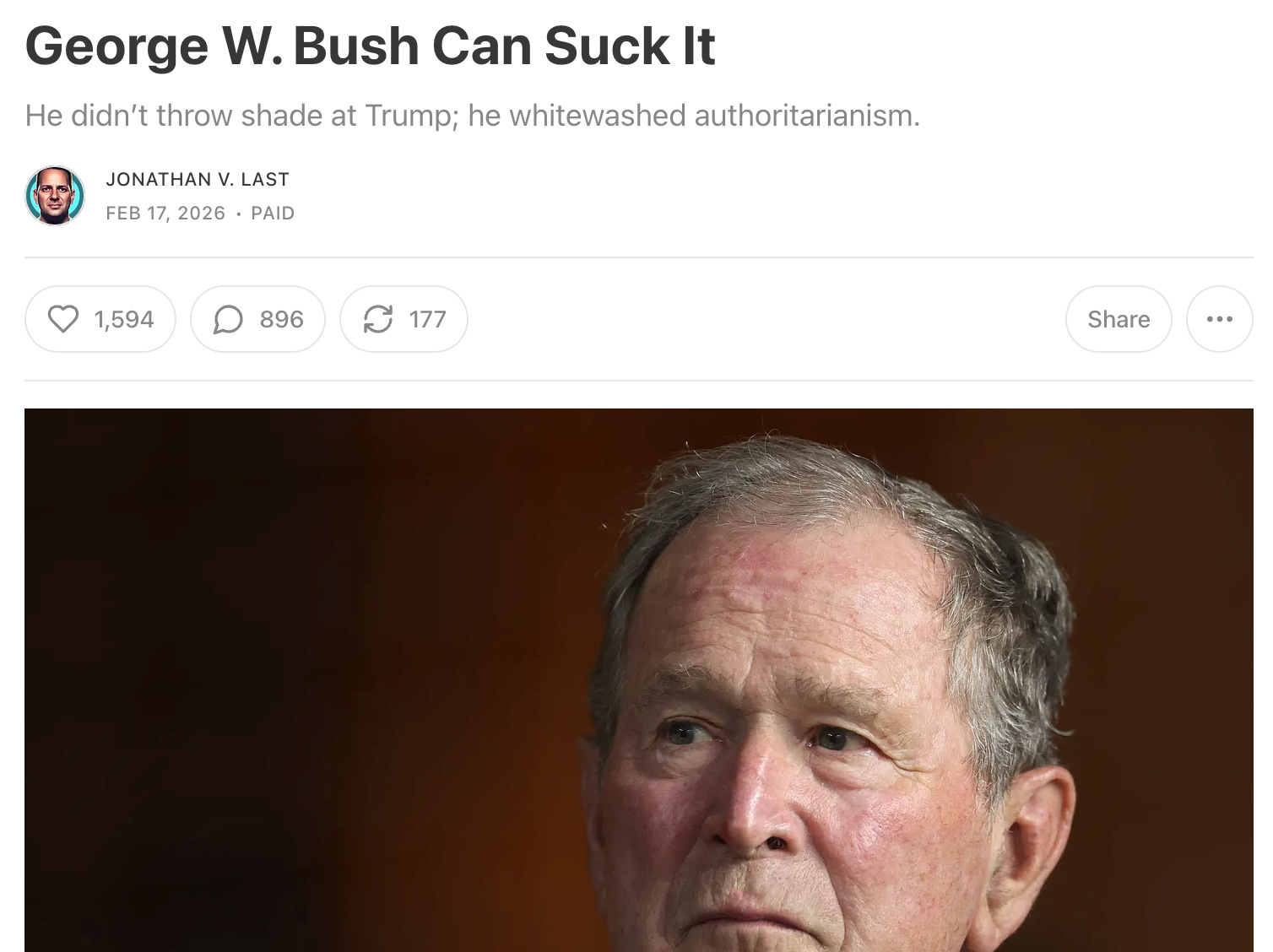
See what I mean? GWB isn’t out there, ranting and raving about Trump, and chose to write an essay about George Washington on President’s Day, so Last accuses him of “whitewashing authoritarianism.” He's demanding that Bush display the correct emotions about the correct subjects, and since Bush declined, that disqualifies him as a person. Last’s critique is just amazingly pedestrian.
Of course, naturally, people will push back. “Hey, if everyone checked out, nothing would ever change!” That’s fair enough, up to a point. But that argument sneaks in an assumption worth challenging: that being emotionally wound up about something counts as engagement. I’d argue it mostly doesn’t. There’s a real difference between civic participation and emotional consumption. Voting, getting involved at the local level, and contributing to something concrete that you can actually see the impact. That’s engagement. Reading hot takes, scrolling through tweets, watching video snippets, feeling terrible, yelling at the television, and repeating the cycle the next morning is not changing anything. If anything, I think the performance of caring has become a way for many people to avoid doing anything, because the performance itself feels like enough.
Not caring about the Epstein files, ICE, Ukraine, the Olympics, Venezuela, the border, the crime rate, the stock market, etc., doesn’t make you a bad person. It might just mean you’re being honest with yourself about what you can actually affect, and choosing not to set your hair on fire over things that will still be there tomorrow, regardless of how you feel about them today. Marcus Aurelius said, “The things you think about determine the quality of your mind.”
That hardly seems like indifference to me, but more like a reasonable way to live.
Once someone is aware of grave abuses like those revealed in the Epstein files, deliberately refusing to care or to form any judgment is itself a moral choice. In a decent society, we do not treat such abuse as a neutral matter; we recognise it as wrong and, at minimum, refuse to collude in minimising it. While not everyone must speak publicly, a wilful refusal to engage even when asked tends to function, in practice, as a form of abdication and helps create a climate in which such wrongs are more easily ignored.